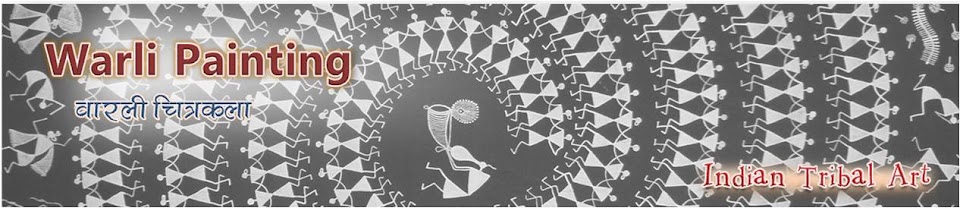

Warli Paintings

Warli Paintings
IntroductionWarli art is a beautiful folk art of Maharashtra, created by the womens of Warli tribe. Warli is the, tribe found on the northern outskirts of Mumbai, in Western India. Warli Art was first explored in the early seventies. It is believed that the art originated in the early 10th century AD. Warli people express themselves in vivid styles through paintings which they execute on the walls of their house. This was the only means of transmitting folklore to a populace not acquainted with the written word. Madhubani.Warli paintings were mainly done by the women folk. The most important aspect of the painting is that it does not depicts mythological characters or images of deities, but depict social life. Pictures of human beings and animals, along with scenes from daily life are created in a loose rhythmic pattern. Warli paintings are painted white on mud walls. The paintings are beautifully executed and resembles pre-historic cave paintings in execution and usually depict scenes of human figures engaged in activities like hunting, dancing, sowing and harvesting.Color and ThemesThe painting is done on an austere mud base using one color, white, with occasional dots in red and yellow. This colour is obtained from grounding rice into white powder. This sobriety is offset by the ebullience of their content. Warli paintings representing Palghat, the marriage god, often include a horse used by the bride and groom. This type of painting is considered sacred and without it, the marriage cannot take place. These paintings also serve social and religious aspirations of the local people. It is believed that these paintings invoke powers of the Gods. Geometric designs dominate most paintings; dots and crooked lines are the units of these compositions. The appeal of these unicolor compositions lies in their lack of pretentiousness in conveying the profound.Modern TrendsWarli artists hardly use a straight line. Instead of line, series of dots and dashes are made. However nowadays modern artists have begun to draw straight lines in their paintings. Warlis have also started to use modern elements such as the bicycle, etc apart from traditional motifs.Warlis are now shifting to paper and cloth paintings. Warli paintings on paper have become very popular and are now sold all over India. Today, small paintings are done on cloth and paper but they look best on the walls or in the form of huge murals that bring out the vast and magical world of the Warlis. For the Warlis, tradition is still adhered to but at the same time new ideas have been allowed to seep in which helps them face new challenges from the market.Symbolism in Warli PaintingsEvery symbols of Warli art has their own meaning and language. Men and women in spiral form and concentric circular designs in Warli Paintings symbolize the circle of life. The harmony and balance depicted in these paintings is supposed to signify the harmony and balance of the universe.


original at - http://www.blogcatalog.com/search.frame.php?term=warli+tribe&id=eba7d5d14b85abe049f392bf382fc48d

Warli tribals and their art

-->-->
India has a rich tradition of folk arts the custodians of which are the many tribes that live in the interiors of various states. Warli painting, named after the tribe that evolved it, is one such highly-popular art-form. The Warli tribals are forest-dwellers but have made a gradual transition towards being a pastoral community. They reside in the West coast of Northern Maharastra. A large concentration is found in the Thane district, off Mumbai. A little backward economically, they still maintain their indigenous customs and traditions. The growing popularity and commercialisation of the Warli painting has seen the uplift of many tribals and they are increasingly becoming integrated with the mainstream. Their marriage traditions are unique to their culture and are a subject matter of avid interest for anthropology students.
Warli paintings The Warli style of painting evolved from its mural form. Even today, it is a tradition with the Warlis to decorate the mud walls of the huts with paintings made in rice paste. The painting on paper is a fall-out of commercialisation. The Warlis indulge in this activity during festivals, on community occasions such as harvesting or rituals such as weddings. They draw inspiration from everyday lives for their themes. Thus, a typical Warli painting will have a village landscape with farms, trees and domestic animals. Farmers cultivating land and marriage ceremonies are other oft-repeated themes. Nowadays, these paintings are made on hand-made paper, usually green or brown, the colour of mud-walls with or without the cow-dung, with white paint. The paintings are simple line drawings, mere outlines with little or no detailing. The human figures in a Warli painting are simple, yet stylish - easy even for a child to master.
Everyday themes While, traditionally the paintings were exclusively farm scenes with huts, off-late modern elements have started creeping in. Cityscapes with its vehicles, schools and other contemporary themes are making way to keep pace with the world outside their community - a bit of a sell-out to draw attention, possibly. But largely, these paintings with traditional themes are still a big draw, both domestically and internationally. These paintings are not too expensive, but some artistes who have made a name for themselves do come up with top draw exclusive paintings, which may be a little steeply-priced.
Quintessential Maharashtra In Maharashtra, many of its tourism buses and offices are adorned with Warli paintings giving it a status of an official symbol. A lot of merchandise - T-shirts, coasters, linen come with Warli designs and motifs and do brisk sales through exhibitions and tourist outlets. Many schools in Maharashtra take workshops in Warli painting for children. You will find Warli paintings on walls of some five-star hotels in Mumbai, too.

original at - http://www.indiaparenting.com/travel/data/travel007.shtml

Warli Paintings - Worli Paintings Maharashtra, Warli Tribal Paintings, Worli Painting

Warli Paintings - Worli Paintings Maharashtra, Warli Tribal Paintings, Worli Painting:


"Warli Paintings
Warli paintings are the tribal wall paintings of the warli tribes of Maharashtra. Warlis are the largest tribes of Maharashtra live in northern outskirts of Mumbai. Womenfolks mainly do the paintings on the mud walls of the houses. Warli painting, which is compared similar to the famous Madhubabi paintings of Bihar, is traced back to 10th century A.D. But it was first discovered only in the early seventies.

Warli paintings generally depict the normal life like images of human beings and animals, along with scenes from daily life. They also depict hunting, dancing, sowing and harvesting scenes. White is the only colour used in creating these paintings, with occasional dots in red and yellow. This colour is prepared by grounding rice into white powder."


original at - http://www.maharashtratourism.net/art-craft/warli-painting.html

Warli Paintings

Warli Paintings

Warli, an Indian folk art painting, has traveled across borders and are now the cherished possessions of many a collector and art lover. This painting derives its name from a small tribe inhabiting the remote regions of Maharashtra. The Warlis are primarily an agriculture-dependant tribe and their houses are made of thatched mud-huts, which are constructed in such a way so that they all surround a central cell. Historians say that the Warli tradition can be traced to the Neolithic period between 2,500 BC and 3,000 BC. During the harvest season, happy occasions like weddings and births, their houses are adorned with a vocabulary of patterns. This custom gave rise to what we now know as the Warli Painting.

Warli Paintings are characterized by the simple style employed to say the profoundest things. Warli PaintingThe use of color is restricted to a stark white against earthen backgrounds. Geometric designs dominate most paintings; dots and crooked lines are the units of these compositions. The monochromatic tribal paintings express various folk imaginations,beliefs and customs. The whims and moods of tribal life make for interesting themes, which is why Warli Paintings are much more than designs on walls, they are authentic depictions of a way of life. However, the philosophy of a way of life, especially those of tribal societies, is best depicted through colorful images.

Trees, birds, men and women collaborate to create a composite whole in Tribal Paintings Warli Paintingand the paintings of the Warli tribe of Maharashtra are the most joyous celebration of that very philosophy. Even spiral formations of men and women and concentric circular designs in Warli Paintings are symbolic of the circle of life. In fact most of these seemingly simple paintings abound in symbolism. The harmony and balance depicted in these paintings is supposed to signify the harmony and balance of the universe. Unlike other tribal art forms the Warli Paintings do not employ religious iconography, making it a more secular art form.

Marriage is the most recurring theme of Warli paintings. Many Warli paintings depict Warli Paintings - Marriage ThemePalghat, the marriage god, accompanied by a horse and of course the bride and the groom. They consider these paintings sacred. Men and women dancing in circles, during various celebrations, is another theme typical to the Warli Paintings. A musician playing a native instrument is usually found in the middle of such spirals. Flora and fauna are also depicted in these paintings. In recent times, these paintings also include a few modern elements like bicycles or transistors tucked in corners of the paintings. The cracked walls of the village of Warli have been adorned with these paintings for centuries and even today they form the primary decoration of most such houses.

original at -http://www.indianetzone.com/2/warli_paintings.htm

वसंत भासरा यांचे चित्र


Warli Paintings From CopperWiki


Warli Art
Warli paintings are folk paintings made by the Warli tribe, the largest tribe in Maharashtra. The Warli tribe resides in Thane district of Maharashtra on the northern outskirts of Mumbai and extends up to the Gujarat border.

Traditionally painted on walls, Warli paintings are a vivid expression of daily and social events of the tribe and provide the only means of transmitting folklore to a community not acquainted with the written word.

Contents

 Why should I be aware of this?

  • They are an example of diversity in Indian art.
  • They tell us about life and communication in those days.
  • Warli Paintings are very different from other folk and tribal paintings in India.

 All about Warli Paintings

While there are no records of the exact origins of this art, its roots may be traced to as early as the 10th century AD. Research suggests that the Warlis are the propagators of a tradition which originated some time in the Neolithic period between 2,500 BC and 3,000 BC.

Characteristics of Warli Paintings

The Warli art form is similar to the pre-historic cave paintings in its execution. These extremely rudimentary paintings use a very basic graphic vocabulary: a circle, a triangle and a square. The circle and triangle come from their observation of nature, the circle representing the sun and the moon, the triangle derived from mountains and pointed trees. Only the square seems to obey a different logic and seems to be a human invention, indicating a sacred enclosure or a piece of land. Human and animal bodies are represented by two triangles joined at the tip; the upper triangle depicts the trunk and the lower triangle the pelvis. While men and women are depicted in almost identical fashion, the only differentiator is the little knot of hair in the form of a bun, that indicates Warli women.

Stylistically, Warli Paintings can be recognized by the fact that they are painted on an austere mud base using one color, white, with occasional dots in red and yellow. The white pigment is a mixture of rice paste and water with gum as a binding agent. This sobriety is offset by the ebullience of their content. Traditionally, when painting the mud walls, the Warlis use a bamboo stick chewed at the end, to make it work like a paintbrush. Even now, when they paint on cloth, they use a narrow stick dipped in white rice flour paste.

Unlike the realism of Kishangarh Paintings, the themes in Warli paintings are highly repetitive and symbolic. Many of the Warli paintings that represent Palghat, the god of marriage and fertility, often include a horse used by the bride and groom. The painting is sacred and without it, the marriage cannot take place.

In Warli paintings it is rare to see a straight line. A series of dots and dashes make one line.

Each painting is usually an entire scene that contains various elements of nature including people, animals, trees, hills etc. The thread that binds all these loose elements can be events like a marriage, a dance, sowing, harvesting or hunting. Different varieties of trees are drawn in detail forming intricate decorative patterns. Birds, squirrels, monkeys, snakes and other animals are also depicted, frequently in action. Other elements in nature like streams and rocks are also featured. The 'Tree of Life' and the 'Tarpa' dance are significant images often seen in Warli art. The Tarpa is a trumpet like instrument and many Warli paintings will have a tarpa player surrounded by drummers and dancing men and women.

The artists have recently started to draw straight lines in their paintings. These days, even men have taken to painting and they are often done on Handmade Paper incorporating traditional decorative Warli motifs with modern elements such as the bicycle etc.

 The Artists of Warli

Originally, Warlis were hunters and so the motifs in their paintings were based on hunting. Today, most of the tribals have shifted to cultivation and work according to the monsoon, and the themes in their paintings have changed. Traditionally, only women practiced this art form on the interior walls of their mud houses.

Understanding Warli Paintings

Although the Warlis live very close to Mumbai, India’s largest metropolis, they shun all influences of modern urbanization. Even though many paint for commercial gain today, they have continued to adhere to old themes and motifs that can only be appreciated by those who know and understand Warli culture.

Warlis worship nature in many forms – sun and moon, god of thunder, lightning, wind, rain etc. Different gods are worshipped in different seasons. In the coming of the first rice crop, they worship the god of rain in a festival called Naranadeva. In other festivals that follow, the Warlis worship the goddesses of fertility, household peace, harvest and many more.

For the Warlis, life is an eternal circle. At all occasions – birth, marriage, and death they draw circles, symbol of Mother Goddess. Death is not the end for them; rather it is a new beginning. Which is why circles best represent the art of Warli, which has neither an end nor a beginning.


 Different from Other Paintings

Warli Paintings are very different from other folk and tribal paintings in India. Their themes are not mythological, nor their colors as bright as the ones seen in Madhubani Paintings. Neither do they contain the robust sensuality of the paintings found in Eastern India. Instead they are painted on mud, charcoal, cow dung based surface using Natural Dyes in white with series of dots in red and yellow.

Their linear nature and monochromatic hues make them similar to pre-historic cave paintings and Aboriginal Art in execution. Warli Paintings usually depict scenes of human figures engaged in activities like hunting, dancing, sowing and harvesting. These paintings also serve social and religious aspirations of the local people, since it is believed that these paintings invoke powers of the Gods.

Warli Paintings Today

Warli paintings were never originally intended to be used for commercial gains. However, after they were discovered twenty five years ago, they became instantly popular, probably because they evoked the trumpets, drumbeats and songs of the Warli tribe through their simple motifs. Soon the tribals realized that the sale of their paintings made economic sense. Today, Warli paintings on Handmade Paper and cloth have become very popular and are sold all over India.


for details go to http://www.copperwiki.org/index.php/Warli_Paintings


Warli painting

Warli painting

A painting on a wall of a Warli house

Warli paintings, at Sanskriti Kendra Museum, Anandagram, New Delhi.
In her book The Painted World of the Warlis Yashodhara Dalmia claimed that the Warli carry on a tradition stretching back to 2500 or 3000 BC. Their mural paintings are similar to those done between 500 and 10,000 BC in the Rock Shelters of Bhimbetka, in Madhya Pradesh.
Their extremely rudimentary wall paintings use a very basic graphic vocabulary: a circle, a triangle and a square. The circle and triangle come from their observation of nature, the circle representing the sun and the moon, the triangle derived from mountains and pointed trees. Only the square seems to obey a different logic and seems to be a human invention, indicating a sacred enclosure or a piece of land. So the central motive in each ritual painting is the square, the cauk or caukat (pronounced "chauk" or "chaukat"); inside it we find Palaghata, the mother goddess, symbolizing fertility. Significantly, male gods are unusual among the Warli and are frequently related to spirits which have taken human shape. The central motif in these ritual paintings is surrounded by scenes portraying hunting, fishing and farming, festivals and dances, trees and animals. Human and animal bodies are represented by two triangles joined at the tip; the upper triangle depicts the trunk and the lower triangle the pelvis. Their precarious equilibrium symbolizes the balance of the universe, and of the couple, and has the practical and amusing advantage of animating the bodies.
The pared down pictorial language is matched by a rudimentary technique. The ritual paintings are usually done inside the huts. The walls are made of a mixture of branches, earth and cow dung, making a red ochre background for the wall paintings. The Warli use only white for their paintings. Their white pigment is a mixture of rice paste and water with gum as a binding. They use a bamboo stick chewed at the end to make it as supple as a paintbrush. The wall paintings are done only for special occasions such as weddings or harvests. The lack of regular artistic activity explains the very crude style of their paintings, which were the preserve of the womenfolk until the late 1970s. But in the 1970s this ritual art took a radical turn, when Jivya Soma Mashe started to paint, not for any special ritual, but on an everyday basis.

please suggest your ideas

hi friends....
nice to see you here,....
welcoem to this blog,
as you know we are starting from scratch, this is first step, so it is just rough idea,...
your innovative ideas are expected to creat our blog attractive, so we canatact more peoples & have cood communication between all...
keep in mind our aim is to..
1. update latest news or trends to blog.
2. post history about place/topic
3. have communication between our members
4. attractive look
5. guidence for new commers.
so please suggest some ides to improve our blog
regards
dahanu calling!!!

warli art @ www.wikipedia.org

HISTORY

Based in the Thane District, about 150 km north of Mumbai, the Warli tribe numbers over 300,000

members. They have their own beliefs, life and customs which have nothing in common with

Hinduism. The Warli speak an unwritten dialect mingling Sanskrit, Maharati and Gujarati words.

The word « Warli » comes from « warla» which means a piece of land or a field. In his book, The

Painted World of the Warlis, Yashodhara Dalmia claimed that the Warli carry on a tradition

stretching back to 2 500 or 3 000 BC. Their mural paintings are similar to those done between 500

and 10 000 BC in the Rock Shelters of Bhimbetka , in Madhya Pradesh.

Their extremely rudimentary wall paintings use a very basic graphic vocabulary: a circle, a triangle

and a square. The circle and triangle come from their observation of nature, the circle representing

the sun and the moon, the triangle derived from mountains and pointed trees.

Only the square seems to obey a different logic and seems to be a human invention, indicating a

sacred enclosure or a piece of land. So the central motive in each ritual painting is the square, the

cauk (or caukat); inside it we find Palaghata, the mother goddess, symbolizing fertility. Significantly,

male gods are unusual among the Warli and are frequently related to spirits which have taken

human shape.

The central motif in these ritual paintings is surrounded by scenes portraying hunting, fishing and

farming, festivals and dances, trees and animals. Human and animal bodies are represented by two

triangles joined at the tip ‹ the upper triangle depicts the trunk and the lower triangle the pelvis. Their

precarious equilibrium symbolizes the balance of the universe, and of the couple, and has the

practical and amusing advantage of animating the bodies.

The pared down pictorial language is matched by a rudimentary technique. The ritual paintings are

usually done inside the huts. The walls are made of a mixture of branches, earth and cow dung,

making a red ochre background for the wall paintings. The Warli use only white for their paintings.

Their white pigment is a mixture of rice paste and water with gum as a binding. They use a bamboo

stick chewed at the end to make it as supple as a paintbrush. The wall paintings are done only for

special occasions such as weddings or harvests. The lack of regular artistic activity explains the very

crude style of their paintings, which were the preserve of the womenfolk until the late 1970s. But in

the 1970s this ritual art took a radical turn. A man, Jivya Soma Mashe started to paint, not for any

special ritual, but on an everyday basis.

Source text from www.wikipedia.org

warli art by khabatti.com

Warli Art
400 yrs old Tribal Art Form Warli art originated in Thane Dist. of maharashtra, western part of India, in a village also know by the name Warli. It is situated near Dhanau. This art is a 2 dimensional, with no perspective or proportion. Warli painting is simple and linear with the maximum use of triangular shapes. As the universal energy YIN/YANG; concept having the upward facing triangle representing the Male and the downward facing triangle representing the Woman. It also represent fertility as the tribal belief revolve around the cycle of Birth and Death. No wedding takes place without the drawing of "mother Goddess" in the front portion of the Bride's house. Usually the paintings are done by married women. Another important ceremony in the "Tarpa Dance". The village head is known as "Bhagat".

copied from from khabatti.com
original source at- http://khambatti.com/shabbir/gallery/main.php?g2_itemId=158